As architecture is designed for a human context, a map for UT3 should be designed for the player context. Ideas and concepts which surround projects vary alot between the physical world and a world which was created. With a map, all the context (aside from possibly history) has to be created rather than just existing, and having to be found. Because of the extent of the concept of context, it would be impossible to emulate the whole context surrounding the unbuilt architecture.
This is where using different ideas to present and influence the original context come into play. Instead of presenting a history or general background information on the building we can use the features and functions exclusive to UT ie. lighting, modeling, texturing and sounds to emulate a feeling or create an atmosphere to reflect on or influence our experience of the context. By using ut the context can be explored and discovered rather than being presented and read, as in tradition documents.
Should this be done? there is no doubt. We are presented with s state of the art game which has oppertunities to create things that defy physical existance, or any kind of restraints. I feel the Falling Water example didn't utilise the HL2 engine for what it was and just presented what was expected. We hope to go a couple steps further to influence the conext by using UT3.
Showing posts with label Context. Show all posts
Showing posts with label Context. Show all posts
Sunday, May 11, 2008

Friday, May 9, 2008
Context
"We are searching for some kind of harmony between two intangibles: a form which we have not yet designed and a context which we cannot properly describe."
- Christopher Alexander
I find that this quote relates quite closely to what we are trying to do with our project. Although we have a design to work from, it is still an unbuilt project and from the images we have to work off it is still quite intangible to us. And then we have the context surrounding it, which is a very board area which we could never explain to it's full extent.
Context refers to a part or parts, which precede, surround, or follow something written or physical. They can also be intimately related and all these things shed light on the certain written or physical something.
There are man different types of context, and even more ways to relate and interpret different contexts. There is also the infamous use of 'out of context' information, which uses information that has been removed from it's surrounding and used in a way to make it mean something else. This introduces the idea of bias and could cause a lack of understanding. For myself, when I was viewing the Falling Water hl2 map, I thought most of the work went into working on making the building and then relying on the viewers previous knowledge of the architectural design to fill in the context. In this example I refer to the lack of physical surroundings, mainly bare uneven surfaces with a tree dabbed here and there, also the history or even the era of the project was not presented in anyway, and general information, apart from the name and architect, was withheld. The lack of context here makes the map seem incomplete and uninteresting.
With the choice of unbuilt architecture it could become hard to do justice to the contextual ideas behind a more famous piece of architecture. If our project was to be aimed at architects, most of our audience would have previous knowledge of the context surrounding the project and freedom of ideas related to context would be limited.
So in regards to our unbuilt architecture, we have a fairly general or intangible context compared with the major of groups. I think this will allow us to progress the project in a way that can relate more directly to ourselves and an outcome that is more personalised and involving for the user, rather than becoming an 'out of context' style design more like a monument or statue dedicated to someone elses idea. Which I think is a very important concept behind using a 3d engine to create architectural designs.
On another note, in our last presentation the importance of our choice in unbuilt architecture was questioned. In researching the context surrounding our choice and the history we found that the project is aimed at providing cheap housing for a high capacity area with comparitively high rents. Here is sydney we are facing the same problem with the pricing of housing increasing all the time. This context in sydney, involves most of the class, who will probably be looking for somewhere to rent in the near future. The importance of our choice comes from the ability to relate the building to our local context, in regards to house pricing, and therefore make it more personal. Also we intend to present how an idea such as market rate housing in an area could be interpreted in and by the context surrounding it.
http://www.brainyquote.com/quotes/quotes/c/christophe173202.html
http://www.brainyquote.com/words/co/context147597.html
- Christopher Alexander
I find that this quote relates quite closely to what we are trying to do with our project. Although we have a design to work from, it is still an unbuilt project and from the images we have to work off it is still quite intangible to us. And then we have the context surrounding it, which is a very board area which we could never explain to it's full extent.
Context refers to a part or parts, which precede, surround, or follow something written or physical. They can also be intimately related and all these things shed light on the certain written or physical something.
There are man different types of context, and even more ways to relate and interpret different contexts. There is also the infamous use of 'out of context' information, which uses information that has been removed from it's surrounding and used in a way to make it mean something else. This introduces the idea of bias and could cause a lack of understanding. For myself, when I was viewing the Falling Water hl2 map, I thought most of the work went into working on making the building and then relying on the viewers previous knowledge of the architectural design to fill in the context. In this example I refer to the lack of physical surroundings, mainly bare uneven surfaces with a tree dabbed here and there, also the history or even the era of the project was not presented in anyway, and general information, apart from the name and architect, was withheld. The lack of context here makes the map seem incomplete and uninteresting.
With the choice of unbuilt architecture it could become hard to do justice to the contextual ideas behind a more famous piece of architecture. If our project was to be aimed at architects, most of our audience would have previous knowledge of the context surrounding the project and freedom of ideas related to context would be limited.
So in regards to our unbuilt architecture, we have a fairly general or intangible context compared with the major of groups. I think this will allow us to progress the project in a way that can relate more directly to ourselves and an outcome that is more personalised and involving for the user, rather than becoming an 'out of context' style design more like a monument or statue dedicated to someone elses idea. Which I think is a very important concept behind using a 3d engine to create architectural designs.
On another note, in our last presentation the importance of our choice in unbuilt architecture was questioned. In researching the context surrounding our choice and the history we found that the project is aimed at providing cheap housing for a high capacity area with comparitively high rents. Here is sydney we are facing the same problem with the pricing of housing increasing all the time. This context in sydney, involves most of the class, who will probably be looking for somewhere to rent in the near future. The importance of our choice comes from the ability to relate the building to our local context, in regards to house pricing, and therefore make it more personal. Also we intend to present how an idea such as market rate housing in an area could be interpreted in and by the context surrounding it.
Related Links
http://www.brainyquote.com/quotes/quotes/c/christophe173202.html
http://www.brainyquote.com/words/co/context147597.html
Wednesday, April 30, 2008
Requeim for a Building
Alright so I've got an idea about how to approach the project towards the end.

 The year is 2000, with the increase of rent throughout Green point, most people are leaving for cheaper areas, or are trying to survive out on the street. A new development was promised by the council to produce a new area at the waterfront to accommodation some of the homeless with cheaper market rate rents. The problem is that the development was rush and has stalled in progress halfway through construction. The people from the street have seen the new development as built for them and ,despite the council and police's attempts to keep them away, they have settled in the half built market rate apartments.
A majority of the homeless were involved with the growing arts scene in the area until the price rises and had stuck around because they thought the area had promise.
As an industrial area with a shipping history, it was still being used as a port, although a lot smaller than neighbouring ones, this made it a prime target from drug importers and the arts community wasn't objecting.
 Set on a rainy night. Our persona (technically the player, creating a linked experience of the building model) is woken up by a knock at the door, hearing his mate asking if he's awake. He rolls off the damp mattress lying in the middle of the room, crooked, flicks on the lamp next to him. A empty room, fridge a one end, couch at the other, is revealed by the flickers light. He heads for the door, but opens it so see no one there, he looks around puzzled and continues out the door, leaving it open behind him.

The persona is then allowed to walk around from his apartment, being lead by noises of people, laughing, smashing windows.
From inside to outside the extend of completion of the building is reveled.
http://en.wikipedia.org/wiki/Greenpoint,_Brooklyn
History of Green point:

- There is a history of conflict within Green point, between the first dutch settlers and the native Indians. Burning farms and murdering children.
- The majority of transport was by boat and most of the settlement was involved with the water.
- In the 19Th century the area became industries and specialised in shipbuilding
- Towards the end of the 20Th century, residential area were starting to be created from the old industrial buildings
- Creative arts was becoming recognised in the area around the same time
- This increased the rent to make in one of Brooklyn's highest rental areas
- Recent years have brought about a building proposition to introduce ~16,700 new residents with cheaper market rate housing
Our Possible Scenario:
 The year is 2000, with the increase of rent throughout Green point, most people are leaving for cheaper areas, or are trying to survive out on the street. A new development was promised by the council to produce a new area at the waterfront to accommodation some of the homeless with cheaper market rate rents. The problem is that the development was rush and has stalled in progress halfway through construction. The people from the street have seen the new development as built for them and ,despite the council and police's attempts to keep them away, they have settled in the half built market rate apartments.
A majority of the homeless were involved with the growing arts scene in the area until the price rises and had stuck around because they thought the area had promise.
As an industrial area with a shipping history, it was still being used as a port, although a lot smaller than neighbouring ones, this made it a prime target from drug importers and the arts community wasn't objecting.
Our Story:
Follows a squatter who wakes up in his apartment (maybe introduce a cut scene) then explores the building from inside out, something a little different from what would be expected from the project outcome.Narrative:
 Set on a rainy night. Our persona (technically the player, creating a linked experience of the building model) is woken up by a knock at the door, hearing his mate asking if he's awake. He rolls off the damp mattress lying in the middle of the room, crooked, flicks on the lamp next to him. A empty room, fridge a one end, couch at the other, is revealed by the flickers light. He heads for the door, but opens it so see no one there, he looks around puzzled and continues out the door, leaving it open behind him.
The persona is then allowed to walk around from his apartment, being lead by noises of people, laughing, smashing windows.
From inside to outside the extend of completion of the building is reveled.
Related links
http://en.wikipedia.org/wiki/Greenpoint,_Brooklyn
Tuesday, April 29, 2008
Wednesday, April 9, 2008
Project: Mayhem
After last nights meeting, and Jack mentioning storyboarding, I thought of having a narrative. Something to guide us in the way we present and gives our map an extra dimension, rather than just being a building. I started to think about our theme word conflict, and came up with the idea of a war torn building and news journalist report style.

Continuing on this tangent, I thought maybe a war scenario probably doesn't relate to New York, where our building is located, so I thought of a hostage style scenario. And why stop with the conflict just as an idea for the map, we could create conflict in our collaboration.
After completing a normal representation of the building, we could split our group into 2 smaller teams, say the hostage takers and the authorities. The team then could create/destroy modify parts of the map to advantage themselves in the scenario. The hostage takes could destroy the entry points, ransack the place, etc. The authorities could bring in extra support cars, cranes, make alternate entry routes, etc.

We could "report" of this activity when we present our work every couple of weeks, kind of like a TV series.
I think it'd probably work best with 2 teams of 2 and an unrelated 1 who helps with modelling, mapping and texturing of either team.
This could start to create an interesting map which no one could really expect. I think it also displays a different perspective of collaboration, we are working to create a final project but using conflicting positions to do so.
I would like to hear what people think about this, otherwise we could just create a map, and talk about stuff.
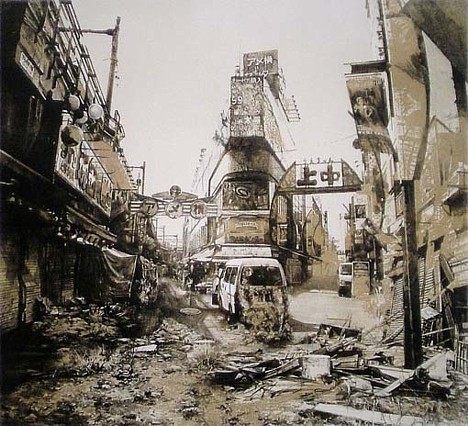
Continuing on this tangent, I thought maybe a war scenario probably doesn't relate to New York, where our building is located, so I thought of a hostage style scenario. And why stop with the conflict just as an idea for the map, we could create conflict in our collaboration.
After completing a normal representation of the building, we could split our group into 2 smaller teams, say the hostage takers and the authorities. The team then could create/destroy modify parts of the map to advantage themselves in the scenario. The hostage takes could destroy the entry points, ransack the place, etc. The authorities could bring in extra support cars, cranes, make alternate entry routes, etc.

We could "report" of this activity when we present our work every couple of weeks, kind of like a TV series.
I think it'd probably work best with 2 teams of 2 and an unrelated 1 who helps with modelling, mapping and texturing of either team.
This could start to create an interesting map which no one could really expect. I think it also displays a different perspective of collaboration, we are working to create a final project but using conflicting positions to do so.
I would like to hear what people think about this, otherwise we could just create a map, and talk about stuff.
Subscribe to:
Posts (Atom)